


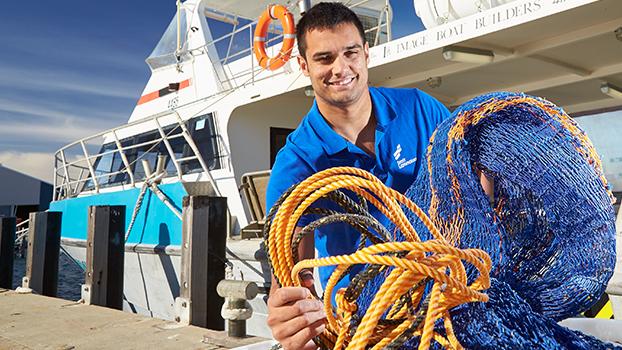
Master fisher
Master fishers work in the commercial fishing industry managing a fishing vessel and fishing operations to catch and preserve fish, crustacean and molluscs. They operate radio, radar, sonar and other navigational aids, as well as check and interpret weather patterns. Master Fishers assist the crew in sorting, cleaning preserving, stowing and refrigerating their catch. They may also be responsible for the maintenance of their vessel and fishing equipment, and the management of their crew. Master fishers usually work based from remote coastal communities located around Western Australia.
Working conditions
Working conditions will vary depending on the type of fishing operations a master fisher is undertaking. Some fishing operations are seasonal, and a master fisher may work continuously – and live out at sea – for extended periods. Master fishers can work long shifts and odd hours, in varied and extreme weather conditions. They are required to maintain strict safety standards on board.
Tools and technologies
Depending on what they are trying to catch, master fishers will use a range of fishing equipment such as trawls, steel pots, nets, long lines and dredges. They also use navigational aids, marine radio to transmit and receive information, and equipment used to interpret weather patterns. They must also wear safety equipment such as life jackets, distress beacons, hard hats, safety boots and high visibility clothing to minimise risks.
Education and training
You can work as a master fisher without any formal qualifications and get training on the job. However, entry to this occupation may be improved if you have experience working on fishing vessels, or a formal qualification in fishing operations or maritime operations.
The Certificates II and III in Fishing Operations are offered at TAFE colleges throughout Western Australia.
Qualifications in maritime operations (Master) are also offered at TAFE colleges and other registered training organisations throughout Western Australia. Training in these qualifications is based around the size of the vessel you wish to operate and the/or the distance from shore you wish to travel. To find a training provider near you, browse the Jobs and Skills WA website or visit the My Skills website. You can also undertake a traineeship in seafood (fishing operations) (level 2 or level 3) The seafood (fishing operations) (level 2) traineeship usually takes 12 months to complete and is available as a school-based traineeship. The seafood (fishing operations) (level 3) traineeship usually takes 24 months to complete.
Share this occupation


Free support and assistance
Your local jobs and Skills Centre can provide free information, support and assistance to help you decide on the best training options to meet your goals.


Disclaimer
The information presented on the occupation profiles within this website is offered as a guide only.